
The Uses Of Large-Scale Enameling

Highway Signs. Company Name signage. Signage promoting Attractions and Features near highways.
These are considered large scale, all used to be done on Steel. Enamel on steel is extremely tough in all weather and outlasts just about any kind of paint. Steel is near impervious to wind. The bending force & angle has to be very acute before the enamel will crack or craze from the severe stress. When properly fired, enamel ground coat chemically bonds with the steel. Bashing with a hammer may chip it, but some enamel will remain bonded. Spray paint from ‘tagging’ situations should easily be removed without disturbing the enamel. Nifty.
Durable, weather resistant
Exterior walls were once made from enameled steel, such as the framing wall of store fronts. Some houses in cities had steel walls on the street side. They were strong, needing no repainting, and signs from steel mills to bakeries were made from steel. For night time viewing, neon tubing or light sockets were added. The history of enamel on steel is long.
permanence
A number of paneled art murals have graced the exterior of tall buildings. Transit tunnels will use enamel art as it is easier to clean, less prone to damage, than tile. Waiting areas need public art, and permanence and durability are components that paper, canvas & glass alone do not have
monumental scale
Now imagine you have some art that you would like to grace a large lobby area of your new building. It will be on public view. It will be lit by both natural light via windows and skylights and indoor lighting. Sometimes, light is art’s worst enemy. In the case of enamel, it is much less of a problem. You can take your scale drawing of the art, work it up to monumental size. Then plan it across however many panels of appropriate sizing to work within the space & with the subject matter of the art. Installation will be left to the engineers, but once installed, it will likely outlast the use of the building. The colors will hold true. Small items from 3rd century BC are still quite beautiful today, and they were NOT on steel, but softer metals.
Large can start small
I have made larger works than can fit in my kiln by breaking up the picture into small tiles. These can be all the same size of 3 inch squares or a mixture of squares and rectangles. Some enamelists have cut copper into puzzle pieces to be refitted after all is done. A larger kiln could take bigger tiles. Until you have a substantial composite ? size at the end.
advantage one
Porcelain enamel has a great advantage. It can be mixed with a binder or media and when the enamel is dry, the piece can be stood up vertically! Many signs companies use a type of vertical kiln to fuse the enamel to the steel. Using silk screen methods or direct and indirect stencils, and it is desirable to work a piece horizontally. When allowed to dry, perhaps another coat or color will be added, allowed to dry, then the panel is hung for its heat treatment. This would allow the artist to transport the art to a larger, rented or borrowed kiln. Dave built his own vertical kiln-quite wonderful. You will see all the solutions to working large in a small studio. Dave is amazing!
yesterday through tomorrow
Dave Berfield takes you through the history and the time tested steps to make lasting porcelain enamel art. Or even commercial signage. Or directional signage. Your choice when you know how to mix, apply and fire, porcelain enamel is a great creative source. Because you can use airbrush and spray guns to apply the enamel wet, you can make 3 dimensional sculptural forms. So, have this video set in your reference library!
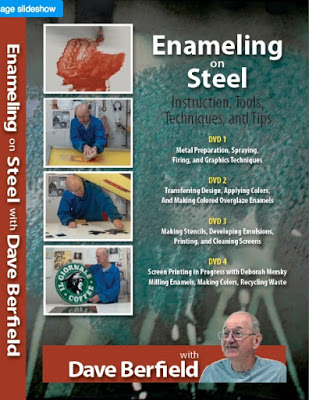

Learn the art of enameling from expert Dave Berfield.
$169.95 for 4 Videos, 6.9 Hours of Instruction and Secrets of Methods for Small Shops
DVD#1: 1 hour 38 minutes:
About the Steel
Cleaning the Steel
Preparing Ground Coat
Checking Specific Gravity
Checking the Set
Spraying the Ground Coat
Firing the Ground Coat
After a Few Minutes
Cleaning the Gun
Applying the Finish Coat
After Spraying Three Coats of Brown
Firing the Finish Coat
Time Passes
After the Panels Cool
Media
Making Finish Coat Colors
Making Overglaze Enamel Colors for Spraying
Applying Graphics
Comparing Use of Finish Coats & Overglazes
Finger Painting & Sgraffito
Using an Airbrush
Using Magnetic Sheeting
Spray
DVD#2: 1 hour 44 minutes
Using Friskets
Transferring Art Work
Cutting the Frisket
Preparing for Spraying
About the Ink
About the Spray Gun
Spraying the First Color
Removing the Frisket
The Second Color
Registration for the Second Color
More about Registration
Spraying the Second Color
Another Way
Making a Last Minute Correction
Firing
About Five Minutes Later
Cleaning the Spray Gun
Wax Resist
Using Roughback
Spraying Finish Coat on Two Trays
First Firing
Minutes Later
A Quick Review
Applying Wax Resist
Second Firing
Minutes Later
Applying Digital Decals
After Firing
Making Colored Overglaze Enamels
Making a Rough Surface for Painting
Some Painting or Drawing Techniques
After Firing
DVD#3: 2 hours
Chapter #1: Screen Printing
Making a Stencil: Coating the Screen
Exposing the Stencils
Exposing Indirect Stencils
Developing the Direct Emulsion
Developing the Indirect Emulsion
Placing the Film
Setting Up
Mixing Silk Screen Ink
Printing
Odds and Ends
The Second Print
Printing Text
Mesh Size
Cleaning Screens
More Odds & Ends
Printing Gold
DVD#4: Part 1, 37 minutes, Part 2, 55 Minutes
Part 1:
Chapter 1: Screen Printing with Dave Berfield, Deborah Mersky and Joe O’Brien
Printing Public Art for John Muir Elementary School
View the actual process of screening enamel onto several large pieces that were
combined to make an even larger sculptural display. Design by Deborah Mersky.
Part 2:
Chapter #2: Milling Enamels
Chapter #3: Checking for Fineness
Chapter #4: Worth Mentioning (Dry Milling Possibility)
Chapter #5: Making Finish Coat Colors with a Blender
Chapter #6: Dave’s Stock of Colorants
Chapter #7: Making Colors with Overglaze Enamels
Chapter #8: Recycling Waste

Learn the ancient art of enameling with expert Dave Berfield. Decades of experimentation and information you cannot find anywhere else!
